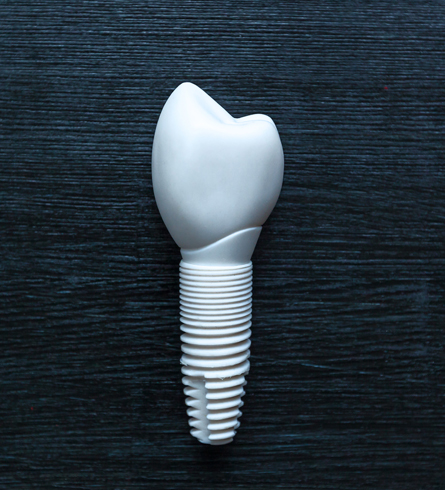
When titanium implants are placed, it seems that titanium oxide escapes and can become fixed in the bone around the implanted area, causing damage to our defence cells.
In our daily lives, we find titanium oxide in a huge number of areas that affect us, such as food, clothing, etc.
Like gluten, there could be a threshold of intolerance to titanium oxide, which could explain some of the current failures with titanium implants. Osteointegration is in reality a phenomenon of isolation of the implant, considered as a foreign body by the immune system.
The zirconia implant will only heal in bone that has become perfectly healthy, which is the aim of our integrative treatments and, in principle, the reason why you come to us.
Thanks to technological developments and the way it is used, zirconia has become the material of choice for implantology. Its white colour is an aesthetic bonus, and we have found that the quality of adaptation of the gum to zirconia is extremely satisfactory. Its neutrality is particularly interesting for electrosensitive people. The development of 3 G, then 4 G and now 5 G networks is a reason, in biological dentistry, to avoid any metal in the mouth.
Objectivity requires us to write that titanium, which has been used since the 1980s, has a clinical background with which zirconia implants cannot yet compete..
It is particularly important when using these implants to control biological parameters such as Vit D3 levels (70 to 100mg/l) and LDL cholesterol (below 1.40).
We have specialized in the use of zirconia implants, which require a different approach to titanium implants.